


News
News
Footwear brands, shoemakers and e-commerce sellers have long protected pairs with plastic shoe trees, foam blocks, polyfill stuffing and plastic bags that arrive with the shoes and end up in a bin. Molded pulp shoe brackets and inserts are replacing that system: they hold the pair's shape, cushion the toe and heel, present the product in the box, and leave behind no plastic to dispose of. This guide explains what pulp shoe packaging does, how dry-press inserts are built, what material and branding options exist, and what a buyer should prepare before ordering custom footwear inserts.
Plastic shoe trees and foam stuffing solve one problem and create several others. They are single-use in most export shipments, add disposal cost at the destination, and increasingly run into retailer sustainability requirements and customs packaging rules. Many chains now ask suppliers to cut plastic fillers or justify them, and DTC brands use unboxing as a marketing surface where a plastic block looks dated.
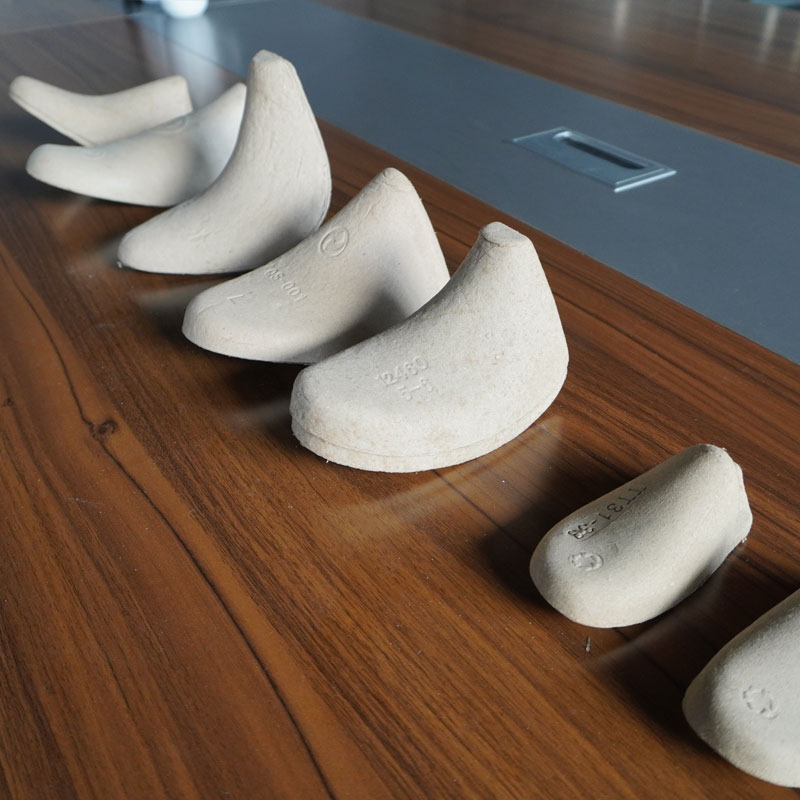
Molded pulp inserts answer those pressures directly. The fiber board or bracket can be recycled as paper alongside the shipping carton, requires no separate sorting, and carries a clean, natural appearance that photographs well for product pages. For brands already labeling packaging as recyclable or plastic-free, a pulp shoe bracket removes the last obvious plastic element inside the box.
A bracket or insert supports the shoe where compression matters most: the toe box, the vamp and the heel counter. Without support, stacked pairs deform during long ocean freight and warehouse handling, arriving flattened or creased. The formed pulp profile holds the shoe open at the toe and elevates the heel so the upper does not collapse against the sole, reducing return complaints tied to transit damage.
Beyond protection, the insert sets the pair up inside the box. A shaped bracket positions the shoe so the customer sees the upper, logo and sole line the moment the lid opens, which matters for boutique footwear and gift packaging. The same function supports in-store trays where pairs are displayed upright rather than flat.
Most shoe brackets are made on the dry pressing pulp process, which differs from the wet-press trays used for food and beverage inserts. Dry pressing forms a thicker, more rigid fiber board with a flatter surface and a firmer edge, suited to holding shape rather than cradling a fragile object. That rigidity keeps the bracket from sagging under the weight of the pair through a long shipment.
Dry-press tooling also tolerates larger, flatter inserts and custom cut profiles, which fits footwear geometry: a bracket spans the toe and heel rather than following a small rounded cavity. Wall thickness and edge stiffness are tuned to the shoe type, from soft sneakers to rigid dress shoes, so the supplier designs the profile against the product rather than supplying a generic block.

Footwear inserts are offered in several fiber grades, each with a different look and cost position.
Primary color (natural) pulp. The unbleached fiber shows a light tan, textured surface that reads as natural and sustainable, and it carries the lowest cost position. It suits casual sneakers, work shoes and value lines where the insert stays mostly inside the box.
White pulp. Bleached fiber gives a clean, bright board that matches premium retail packaging and light-colored gift boxes. White inserts are common for dress shoes, children's footwear and branded gift sets where the insert is visible when the lid opens.
Colored or treated pulp. Fiber can be tinted or finished to align with brand colors, though color adds cost and should be specified against the packaging brief. Surface finish also affects how embossing reads, so branding and material are chosen together.

A pulp bracket can carry the brand without a printed sticker. Embossed logos, size marks and model numbers are pressed into the board during forming, which keeps branding on the insert itself rather than on a separate label that can peel. Custom sizing matches the last or the pair's dimensions, and the bracket can be shaped as a single piece or a two-part set for left and right support.
Buyers also specify whether the insert nests flat for efficient shipping of empty brackets to the packing line, and whether it needs a tab or handle for easy removal. These details affect tooling and should be decided at the design stage rather than after the mold is cut.
To open a custom mold, the supplier needs the product and packaging dimensions rather than a verbal description. Prepare the following before requesting a quote.
From this brief the supplier proposes a bracket profile, opens a sample for fit testing, and adjusts before production tooling is finalized. You can review the molded pulp shoe bracket option and the primary color dry pressing tray as reference forms.
Pulp shoe packaging removes plastic fillers while protecting the pair and supporting a clean unboxing, and dry-press construction gives the stiffness footwear needs through export transit. Matching the bracket profile to the shoe and the box, choosing the right fiber grade, and planning branding early keeps cost and quality in control. Browse the full molded pulp product range, and if you have a shoe sample, box dimensions or a target volume, contact our team with the brief for a custom bracket quote and sample.


 +86 189 2452 1063
 s-dzhiyuan@163.com
 18924521063



Online Message

Follow Us


Top
